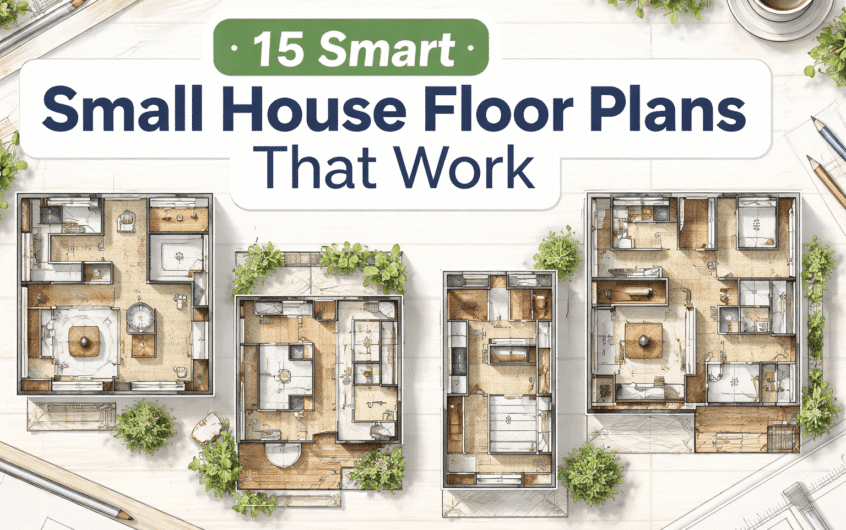

Small house living is no longer about sacrificing comfort. With the right planning, small house floor plans can deliver excellent functionality, modern aesthetics, and long-term affordability, especially when paired with smart space-saving home ideas. Whether you are building a compact home, downsizing, or planning an ADU, smart layouts make every square foot count.
This guide explores 15 smart small house floor plans that truly work, explaining why each layout is effective, who it’s best for, and how it maximizes space.
Table of Contents
-
Studio Urban Loft Floor Plan
-
One-Bedroom Open Concept Layout
-
Studio With Home Office Nook
-
Two-Bedroom Side-by-Side Plan
-
Split-Bedroom Small House Design
-
Central Kitchen Floor Plan
-
Narrow-Lot Two-Story House
-
Compact Ranch-Style Layout
-
U-Shaped Courtyard House Plan
-
L-Shaped Indoor-Outdoor Layout
-
Tiny House With Loft
-
Cabin-Style Small Home Plan
-
Backyard ADU Studio Plan
-
Work-From-Home Flex Layout
-
Multigenerational Small House Plan
-
FAQs About Small House Floor Plans
1. Studio Urban Loft Floor Plan (300–450 sq ft)
A studio urban loft removes interior walls to create one open, flexible living space. Sleeping, cooking, and relaxing areas are defined by furniture instead of partitions.
Why it works:
This plan eliminates wasted hallway space, making the home feel larger than it actually is.
Best for:
Singles, rental properties, city living, Airbnb homes.
Space-saving features:
Murphy beds, wall-mounted shelving, fold-down dining tables.
2. One-Bedroom Open Concept Floor Plan (500–650 sq ft)
This is one of the most popular small house floor plans because it balances privacy with openness. The bedroom is enclosed, while the kitchen, dining, and living areas remain open.
Why it works:
Privacy without closing off the home, better airflow, strong resale appeal.
Best for:
Couples, first-time homeowners, downsizers.
Open layouts like this are a core part of modern small home planning and are commonly featured in open concept home layouts designed for efficiency.
3. Studio With Home Office Nook (600–750 sq ft)
Designed for modern lifestyles, this layout includes a built-in workspace without needing an extra room.
Why it works:
Supports remote work while keeping the footprint compact.
Best for:
Freelancers, remote workers, students.
4. Two-Bedroom Side-by-Side Floor Plan (700–850 sq ft)
Both bedrooms are placed next to each other, usually toward the back of the home, with shared living spaces in front.
Why it works:
Simple plumbing layout, cost-effective construction, easy family supervision.
Best for:
Small families, guest room setups.
5. Split-Bedroom Small House Plan (800–900 sq ft)
Bedrooms are located on opposite sides of the house, separated by shared living areas.
Why it works:
Provides privacy and reduces noise transfer.
Best for:
Roommates, couples with guests, multigenerational living.
Split-bedroom designs work best when combined with practical small house renovation ideas that improve privacy and storage.
6. Central Kitchen Floor Plan (850–950 sq ft)
The kitchen sits at the heart of the home, connecting all spaces.
Why it works:
Improves traffic flow, encourages social interaction, reduces wasted space.
Best for:
Families and home cooks.
A central kitchen becomes even more effective when paired with efficient compact kitchen design ideas that reduce clutter.
7. Narrow-Lot Two-Story House Plan (900–1,050 sq ft)
Built vertically instead of horizontally, this design is ideal for narrow land plots.
Why it works:
Separates public and private spaces while fitting small lots.
Best for:
Urban homes, city developments.
8. Compact Ranch-Style Floor Plan (1,000–1,200 sq ft)
A single-story layout with all rooms on one level.
Why it works:
Easy maintenance, accessibility, smooth room flow.
Best for:
Seniors, families, long-term homeowners.
Ranch-style layouts are also popular among homeowners looking for affordable home building tips that reduce long-term costs.
9. U-Shaped Courtyard House Plan (900–1,100 sq ft)
Living spaces wrap around a private courtyard.
Why it works:
Brings in natural light, improves ventilation, enhances privacy.
Best for:
Warm climates, design-focused homeowners.
10. L-Shaped Indoor-Outdoor Floor Plan (850–1,050 sq ft)
This layout creates a defined patio or garden area connected to the living room.
Why it works:
Extends living space and improves indoor-outdoor flow.
Best for:
Entertainers, outdoor-focused lifestyles.
11. Tiny House With Loft (300–450 sq ft)
Sleeping space is moved to a loft, freeing the main floor.
Why it works:
Maximizes vertical space and keeps the living area open.
Best for:
Minimalists, vacation cabins, off-grid living.
This layout is commonly used in minimalist living and pairs well with practical tiny house living tips.
12. Cabin-Style Small Home Plan (500–700 sq ft)
A simple and cozy layout inspired by rustic living.
Why it works:
Easy to build, affordable, warm atmosphere.
Best for:
Vacation homes, rural properties.
13. Backyard ADU Studio Plan (350–500 sq ft)
Accessory Dwelling Units (ADUs) are standalone small homes built on existing property.
Why it works:
Adds rental income and increases property value.
Best for:
Homeowners and real estate investors.
Backyard ADUs are often built using proven backyard ADU construction guides to meet local regulations.
14. Work-From-Home Flex Floor Plan (800–950 sq ft)
Includes a flexible room that can function as an office, guest room, or nursery.
Why it works:
Future-proof design that adapts to lifestyle changes.
Best for:
Remote workers and growing families.
15. Multigenerational Small House Plan (950–1,100 sq ft)
Designed for extended families sharing one home.
Why it works:
Private sleeping zones with shared living areas.
Best for:
Parents living with adult children or aging relatives.
Many of these layouts also benefit from smart space-saving storage ideas that help keep small homes organized.
FAQs About Small House Floor Plans
What is the best small house floor plan?
Open-concept, split-bedroom, and central kitchen layouts are among the most efficient and popular designs.
Are small house floor plans cheaper to build?
Yes, they typically cost less due to reduced materials, labor, and foundation size.
How can a small house feel bigger?
Open layouts, natural light, high ceilings, and indoor-outdoor connections make small homes feel larger.
Storage solutions are a key part of modern small house designs that focus on functionality.
Final Thoughts
Choosing the right small house floor plan is about efficiency, comfort, and future needs. Smart layouts allow compact homes to feel open, functional, and welcoming—without unnecessary costs. Choosing the right layout becomes easier when guided by proven home improvement planning guides.